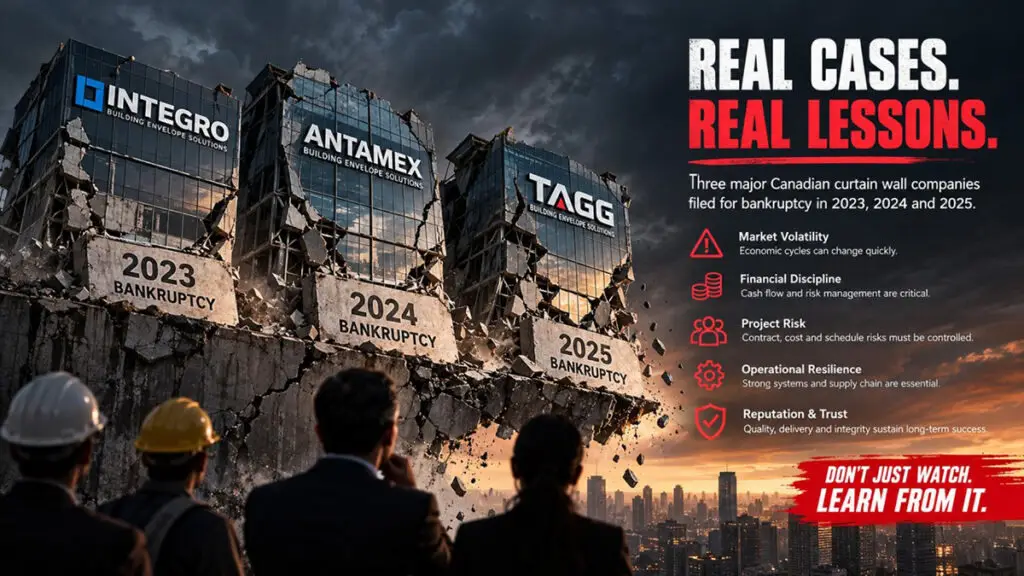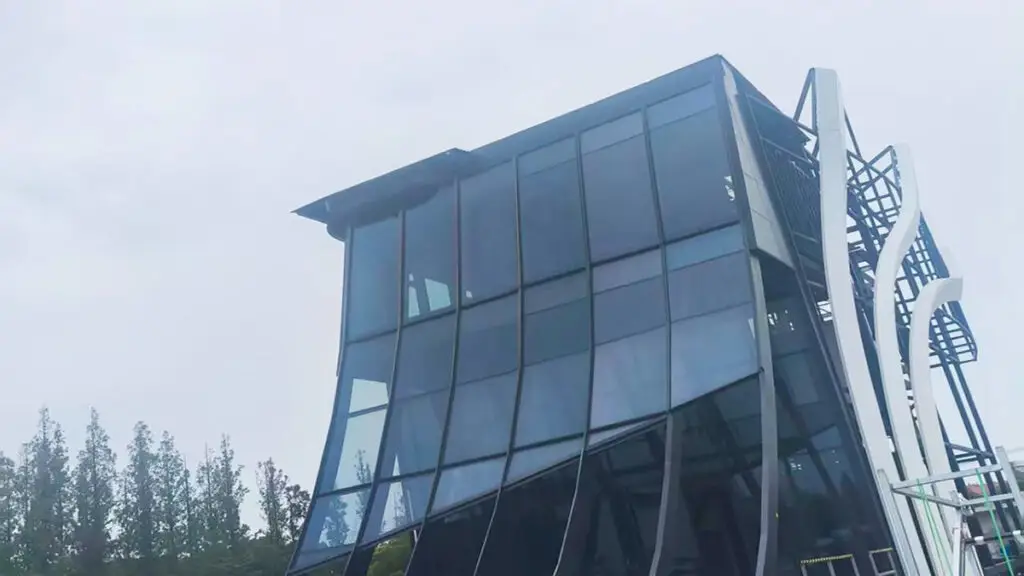
Here’s a story from a client in eastern Canada. He had a 30,000 sq.ft project to complete, and 200 pieces IGUs were needed on site in 4 weeks. The answer he gets from the previous supplier: ETA 12~14 weeks, and prices subject to material pricing change accordingly.
The IGUs were being fabricated overseas. The raw materials were subject to new tariffs. The shipping window had shifted. The project timeline had not. That similar conversation – or some version of it – is still happening now.

What changed, and when?
In March 2025, the U.S. government imposed a 25% tariff on imports from Canada and Mexico.
For the architectural glass industry, the immediate pain landed hardest on aluminum — curtain wall framing costs jumped 11–18% in some categories within months. Tariffs and other economic factors including global supply-chain disruptions, commodity markets, and energy prices affected the costs to manufacture, sell, and import glass and metal products across the industry.
The Canadian Construction Association’s Winter 2026 Economic Insights Report found that 16% of construction businesses reported major negative effects from Canadian counter-tariffs, while 13% reported major disruptions from U.S. tariffs on Canadian goods.
Processed glass — tempered glass, laminated glass & IGU — have not been immune. Vitro described the current environment as a “new reality” that has impacted the supply chain at all levels, and the company has been working to increase domestic production capacity and local sourcing as a result.
The real problem isn’t the tariff rate — it’s the unpredictability
Construction projects run on fixed budgets and fixed schedules. Neither tolerates a supplier calling a few weeks before delivery to say the unit price has changed.
For Canadian glazing contractors and facade companies, the challenge is compounded by a structural gap: Canada does not manufacture float glass domestically. The country’s architectural glass sector depends entirely on imports — and counter-tariffs on float glass are creating pressure on the entire processing supply chain upstream.
The response from experienced buyers has been to reduce exposure to long international supply chains and prioritize suppliers who can deliver from within North America on reliable timelines.

What this means for processed glass specifically?
Processed glass is not a commodity. An IGU is built for a specific facade panel or window opening — with a defined specification, thickness, spacer width, and customized dimensions — can not be swapped for an alternative when a shipment is delayed or a price changes post-order.
This is where the supply chain risk concentrates. A project can absorb a 3% increase in drywall. It cannot absorb a 12 week delay on 200 custom IGUs already in the installation schedule.
The questions that matter for processed glass procurement right now:
* Lead time certainty: Can your fabricator commit to a delivery window and hold it, regardless of what is happening in global shipping?
* Price stability: Is your quote fixed at time of order, or subject to revision between order and delivery?
* Custom capability: Can the fabricator produce non-standard coatings, and configurations without routing through a third-party processor?
* Proximity to the project: How many borders, ports, and inspection points sit between the fabrication facility and your job site?
WHTB’s position in this market

WHTB Glass fabricates processed architectural glass from our facility in Long Island, New York. For Canadian clients — glazing fabricators, facade contractors, and window manufacturers across Ontario, Quebec and The Canadian Maritimes — that location matters in the current environment.
No cross-Pacific shipping: our Long Island facility is within 1–2 days’ trucking of most major Eastern Canadian construction markets. No ocean freight, no port delays, no customs complications from Asia-origin shipments, particularly for initial-stage or first-batch project supply.
USMCA-compliant supply: Product fabricated in the United States and shipped to Canada moves under the USMCA framework — not subject to the counter-tariff structure affecting goods arriving from other origins.
Custom processed glass: We build Low-E insulated glass units, laminated glass, digital ceramic printed glass, and custom curtain wall panels to project-specific specifications — standard and non-standard sizes, short run and volume orders.
Shorter, more reliable lead times: For custom processed glass, our typical turnaround is substantially shorter than overseas fabrication, without the exposure to shipping variability that has disrupted Canadian project schedules over the past 18 months.
Urgent supply combines regular supply: WHTB is the ONLY manufacturer from China who can combines US local production & China production, which means we can meet your urgent supply request & value for money supply.

The sourcing conversation has changed
Twelve months ago, many Canadian glazing buyers chose overseas fabricators primarily on unit price. Today the full cost calculation looks different — because price unpredictability, extended lead times, and border friction carry real project costs.
The buyers adjusting their sourcing strategies now — building relationships with North American fabricators, locking in pricing earlier, and reducing exposure to long international supply chains — are the ones whose projects are running on schedule.
If you want to understand what WHTB can supply, the timelines we can commit to, and how our pricing works for Canadian projects, connect with me directly.