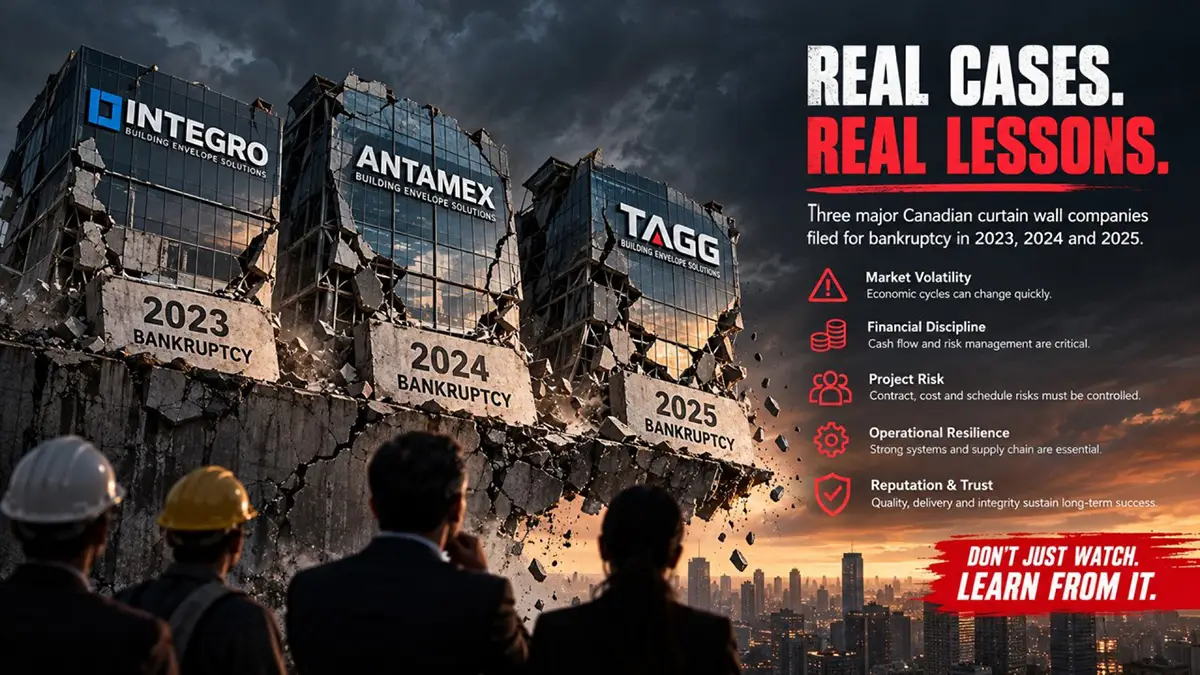
On August 31, 2023, Integro Building Systems – one of the largest curtain wall manufacturers and installers in North America, operating out of Vaughan, Ontario – filed for bankruptcy. Liabilities: listed $56 million to over 600 creditors.
On March 18, 2024, Antamex Industries filed an assignment into bankruptcy, pursuant to the Bankruptcy & Insolvency Act and B. Riley Farbar Inc., LIT was appointed as Trustee in Bankruptcy.
On October 27, 2025, TAGG Group, a curtain wall fabricator (included sister companies KMI and M&G Steel), filed for bankruptcy.
Three companies. Combined experience spanning over six decades in the Canadian glazing and facade industry. All gone within 26 months of each other. At what point does a run of bad luck become a structural problem?
The Pattern
Three different triggers. One shared anatomy.
Fixed-price contracts in a market where costs moved freely
Every company here held fixed-price commitments – made before COVID, before rate hikes, before tariffs – that could not absorb what followed. Integro named it explicitly in its own filings. TAGG’s founder described it publicly. Antamex did not survive long enough to have that conversation.
This is not a Canadian-specific problem. Construction lawyers across North America have described it the same way: the bankruptcies arise primarily out of issues with material volatility and the inability to adjust fixed-price contracts.

US project exposure without adequate protection
All three companies had meaningful US revenue exposure. When that exposure turned – through a problem project, a partner company failure, or a tariff announcement – the damage was not a margin reduction. It was a capital crisis.
Integro’s US operations collapsed in Florida before the Canadian entity followed. Antamex lost its US manufacturing platform when a partner was evicted from a Connecticut plant. TAGG lost nearly half its signed backlog in a week when tariff announcements hit its cross-border project pipeline.
All three companies were caught without enough structural protection against those risks.
Liquidity destroyed faster than it could be rebuilt
In each case, the company retained the technical capability and the project pipeline to trade its way through difficulty – but could not do so because working capital had already been eroded to the point where recovery was impossible.
Payment disputes, loan defaults, and CRA enforcement tied up the funds that a recovery would have required. By the time the final trigger arrived – a tariff announcement, a loan call, a court-ordered lockout – there was nothing left to absorb it.
A market that stopped replenishing the pipeline
Declining commercial office demand from remote work hit Integro directly and was a background condition for all three companies. Toronto’s new condo sales fell 95% from their 2021 peak. The companies that needed new revenue to recover were operating in a market that was offering less of it than at any point in a decade.

What This Means for Everyone Still in the Market
The three companies that closed were not outliers. They were among the most experienced and capable glazing and curtain wall businesses in Canada. Their failures were not primarily technical – they were failures at the intersection of contract structure, capital management, cross-border exposure, and market timing. Every one of those conditions remains present in the Canadian construction market today.
For glazing contractors, facade subcontractors, and the suppliers and GCs who work with them, there are concrete questions worth asking now:
On contract structure: Are your active contracts fixed-price across a multi-year timeline? If material or labour costs move before completion, does the contract give you any mechanism to recover those costs?
On US exposure: If you have US project revenue, what happens to your Canadian business if that revenue is disrupted – by a tariff change, a partner company failure, or a problem project? TAGG lost nearly half its signed backlog in a week. Antamex lost its US manufacturing platform in a month. Is your business structured to absorb that kind of shock without triggering a liquidity crisis?
On working capital and payment rights: Ontario’s Construction Act prompt payment provisions require owners to pay GCs within 28 days and GCs to pay subcontractors within 7 days thereafter. The adjudication process exists to resolve payment disputes without multi-year litigation. Knowing your rights and using them – rather than absorbing payment delays as a cost of doing business – is not a minor administrative matter in the current environment. It is how working capital survives.
On your supplier relationships: When a glazing contractor under financial pressure calls their glass fabricator, what happens? Custom orders get deprioritized. Pricing becomes less predictable. Lead times extend for clients who represent higher credit risk. The companies that maintained stable, trusted supplier relationships through the downturn will have a material operational advantage when the next cycle begins – because that advantage is already priced into their project timelines and cost certainty.

What Comes Next
The same supply cliff created by Toronto’s condo collapse – completions projected to fall from 31,000 units in 2025 to approximately 8,000–10,000 by 2029 – will eventually reverse. Population grows. Housing demand is structural. Early signals in premium downtown office markets in Toronto and Vancouver suggest the commercial cycle is already beginning to turn.

When the next cycle begins, it will start with a glazing and curtain wall industry that is materially smaller than it was in 2022. Three of Canada’s most capable companies are gone. Others have contracted significantly. The skilled workforce is thinner. The bonding market is tighter. New entrants will face a qualification and capacity barrier that takes years to clear.
The pattern that brought down Integro, Antamex, and TAGG is not a mystery. It is a documented sequence that left clear markers at every stage – in court filings, in Glass Canada’s reporting, in the public statements of the people who ran these companies.
The industry has the evidence now. What it does with it is the only open question.
Were you or your company affected by any of these closures — as a creditor, a project partner, or a subcontractor left with unfinished work? What did it change about how you manage contracts or supplier relationships? This is a conversation the industry needs to have openly.