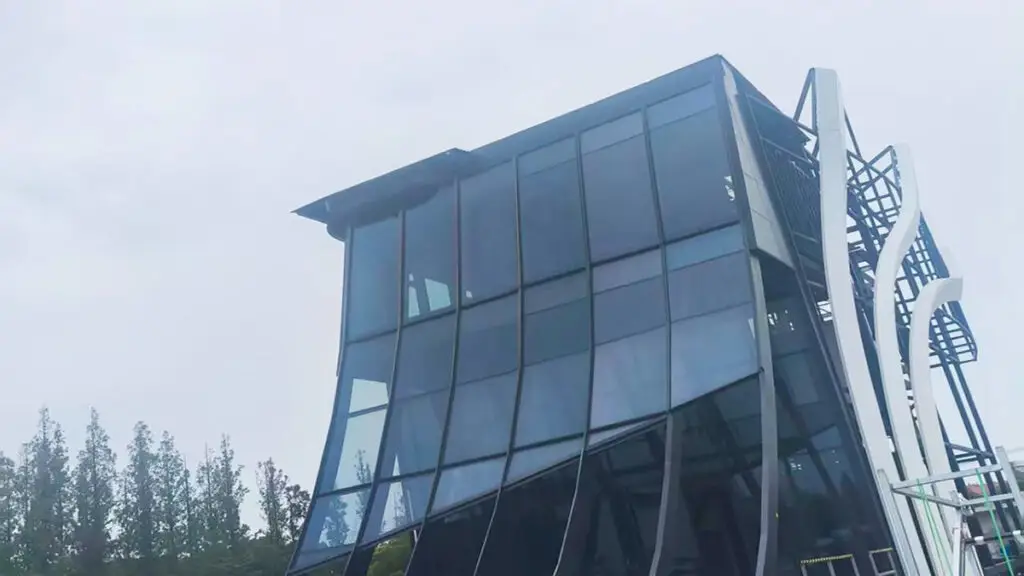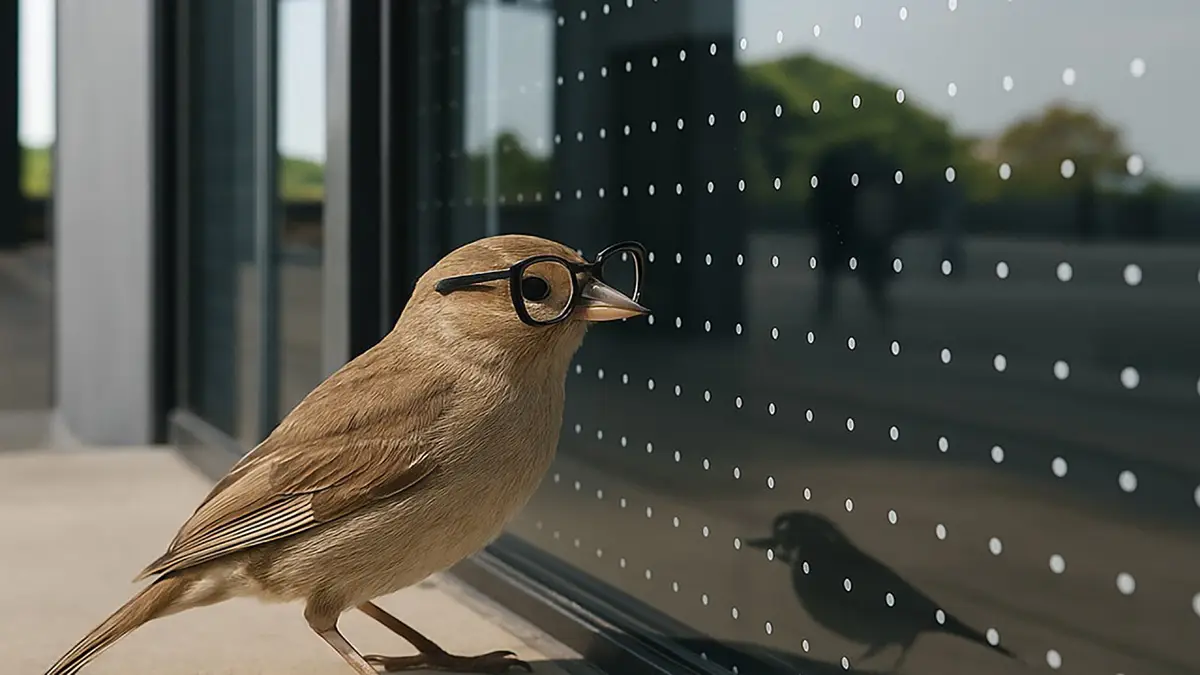
Bird collision happens 2 billion times a year across the U.S from buildings. Most of the collisions happen in the first 30 meters off the ground, where the glass is closest to the trees and street-level plantings.
The construction industry has known this for a long time. And for most of that time, doing something about it was optional. However, this changed on January 30, 2026.

ASHRAE officially approved new bird-friendly glazing requirements as part of its building code. What arrived in January: a single, technically specific standard that applies to new buildings and facade renovations across the continent. For anyone specifying, supplying, or installing glass on commercial projects in North America — this is now part of the job.
What the new rules actually say
Where bird-friendly glass must be installed:
- Not less than 90% of the area of vertical fenestration, glass spandrel, and skylights below 100 feet above grade on new buildings
- Not less than 90% of vertical fenestration being replaced during existing building renovations
- Not less than 90% of vertical fenestration adjacent to and within the first three stories above roof areas with vegetation or water features (green roofs, landscaped terraces)
- All glazed corners, fly-through conditions, glazing adjacent to courtyards, skywalks, building connectors, railings, noise barriers, and wind barriers below 100 feet above gra

What qualifies as bird-friendly glass:
Visual markers on the first or second surface of the glazing that are:
- No smaller than 1/8’’ in any dimension
- No more than 2’’ apart between linear continuous markers
- Arranged in a density pattern where a circle no larger than 2.7’’ in diameter will fit between discrete point markers
The standard permits opaque, translucent, or ultraviolet reflective markers — giving specifiers meaningful flexibility in how they meet the requirement aesthetically.
Why 56% of the Problem Happens Below 100 Feet
The 100-foot threshold in Addendum o is not arbitrary, while:
- A 40 stories office tower does not need bird-friendly glass on floors 20 through 40. It needs it on the first 10 stories, plus any glazed components adjacent to rooftop green spaces.
- A 4 stories commercial building needs bird-friendly glass across essentially its entire glazed facade.
- A curtain wall retrofit project involving glazing below 100 feet is now subject to the requirement during renovation.
For facade contractors and glazing specifiers, it is becoming the baseline specification for the bottom portion of almost every commercial project.
Four Types of Bird-Friendly Glass: What Architects Need to Know
1. Silk Printing or Digital Printing
The most widely specified options: the printing can be dots, lines, or custom patterns — and can be combined with Low-E coatings on #2, or independently on #1 with Low-E coatings on #2.

- Effectiveness: 70–90% collision reduction, depending on pattern density
- Design flexibility: the highest customized patterns available
- WHTB capability: WHTB’s core capabilities
2. Acid-Etched Patterns
The glass surface is treated with acid to create a frosted or patterned texture, that breaks up reflections and makes the glass more visible to birds. Acid is one of the more affordable options and can produce subtle, elegant results. It is particularly effective for lower-rise buildings and podium levels.
- Effectiveness: 60–90% depending on pattern density
- Design flexibility: higher customization
3. Laminated Interlayer Patterns
Bird-friendly patterns can be incorporated into the interlayer of laminated glass — either as a printed film or as a patterned element. This approach is particularly suitable for applications where laminated safety glass is already required (glass railings, overhead glazing, spandrel panels). The pattern is protected between the glass lites and is therefore more durable than surface-applied treatments.
- Effectiveness: Comparable to frit when properly specified
- Design flexibility: High — compatible with safety glazing requirements
4. UV Reflective Coatings
A transparent coating applied to the glass surface that creates patterns visible in the ultraviolet spectrum (300–400 nanometers). Birds can see UV light — humans cannot. To the human eye, the glass appears fully clear. To a bird, the pattern is clearly visible.
UV coatings are the preferred solution for projects where aesthetic transparency is paramount — luxury commercial facades, full-height glazed lobbies, and premium residential towers. Guardian Glass’s Bird1st UV product is the leading commercially available example in North America.
- Effectiveness: 85–90% collision reduction
- Design flexibility: Medium — invisible to humans but pattern options are limited
The Specification Decision: What to Ask Your Glass Supplier
When specifying bird-friendly glass to meet ASHRAE 189.1 Addendum o, the following questions should be part of every conversation with your glass fabricator:
1. Is the pattern on the correct surface?
To qualify as bird-friendly, the visual marker pattern must be on the #1 or#2 of the IGU. Patterns on inner panes do not meet the standard’s intent.
2. Does the pattern meet the spacing requirement?
The ASHRAE standard requires that no gap larger than 2.7’’ in diameter exists between point markers. Many fabricators reference the ABC’s “2×4 rule” (smaller than 2’’ horizontally & 4’’ vertically between markers).
3. Is it ABC-certified?
The American Bird Conservancy maintains a certified materials list evaluated against their Bird Collision Deterrence Standard. Specifying ABC-certified products is the most defensible compliance path and is increasingly required by municipal authorities.

4. How does it combine with your Low-E specification?
Bird-friendly patterns and Low-E coatings can coexist in the same or opposite surface. Confirm compatibility before finalizing your glazing specification.
5. Can the fabricator produce custom patterns?
Standard dot-grid patterns meet the code — but they are not always the best design outcome for premium projects. WHTB’s digital printing enables custom branded or architectural patterns that meet the technical requirements while contributing meaningfully to the building’s visual identity.
What This Means for Your Next Project
If your project is a new commercial or institutional building with glazing below 100 feet above grade in a jurisdiction that has adopted ASHRAE 189.1 — bird-friendly glass is now a baseline requirement.
If your project is a facade retrofit involving the replacement of glazing in the bottom 30 meters of an existing building — Addendum o now applies to that replaced glazing.
WHTB supplies custom bird-friendly glass solutions including silk printing, digital printing, acid-etched, and Low-E IGUs compatible with bird-friendly surface treatments.
A Final Note
The birds that migrate over Canadian and American cities every spring and fall do not see glass. They see sky, trees, and open space — reflected back at them in a fatal illusion. The glass industry has known this for decades and has developed effective, affordable, architecturally compatible solutions.
What was missing was the regulatory framework to make those solutions standard practice. That framework is now arriving — addendum by addendum, city by city, code cycle by code cycle.
The architects and contractors who understand these requirements now, and who have a glass supplier capable of delivering compliant solutions on time and at scale, will be the ones their clients call first.

WHTB is a Low-E glass manufacturer and architectural glass processor with facilities in Long Island, New York and two production facilities in China. We supply Low-E IGUs, laminated glass, digitally printed and ceramic frit bird-friendly glass, bent and curved glass, and custom curtain wall glazing for commercial projects across North America.